
Functional Peptides in Nutraceuticals: How to Match Benefits to Product Positioning
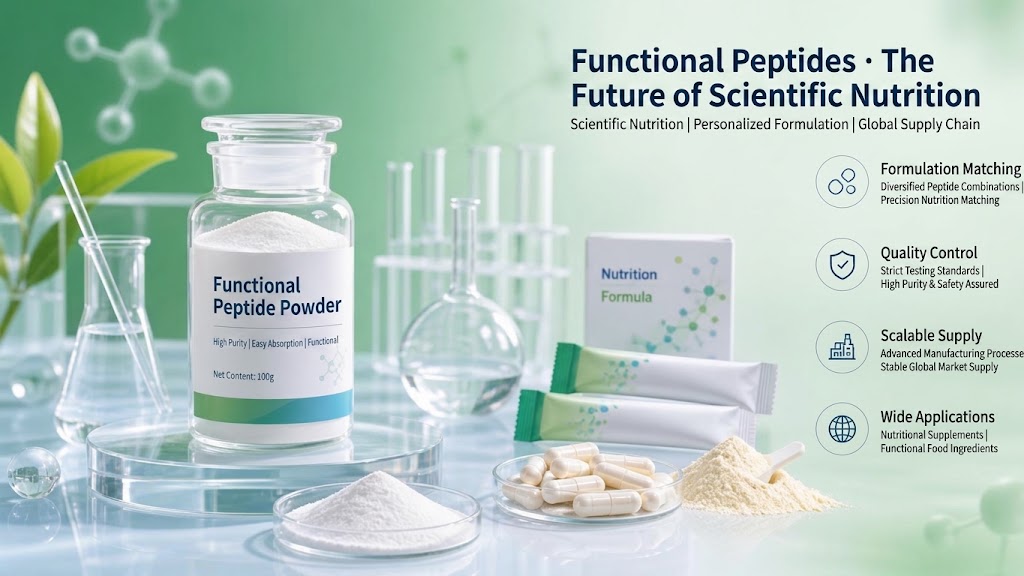
Functional Peptides are reshaping nutraceutical innovation, but choosing a peptide is rarely just a technical exercise. The same ingredient can look highly promising in R&D and still fail commercially if its benefit profile does not fit the intended product story, dosage form, target user, price band, or regulatory pathway. For companies working in biopharmaceutical materials and adjacent health product markets, that mismatch is often where projects lose time and margin.
In practice, the central question is not “Which peptide is effective?” It is closer to “Which peptide can support the benefit claim direction, formulation design, supply plan, and market position we actually want to build?” That shift in thinking matters because nutraceutical buyers do not evaluate ingredients in isolation. They evaluate finished products through a mix of efficacy expectations, trust in scientific backing, convenience, label appeal, and price tolerance.
This is where Functional Peptides stand apart from many conventional actives. Their appeal usually comes from a more targeted mechanism, a clearer structure-function narrative, and the possibility of designing products around specific outcomes such as recovery, beauty-from-within, metabolic support, healthy aging, or cognitive performance. But the commercial result depends on how tightly those benefits are matched to positioning.
Benefit alignment starts with the product promise, not the ingredient list
A common mistake in early-stage nutraceutical development is selecting a peptide because it is technically interesting, then trying to reverse-engineer a market concept around it. That can produce vague positioning: a formula that claims wellness, vitality, beauty, and recovery all at once, without giving buyers a clear reason to choose it.
A better sequence is to define the commercial role of the product first. Is it meant to be a premium specialist SKU with strong scientific depth? A fast-moving consumer format for broad daily use? A clinically adjacent concept intended to win trust with practitioners or sophisticated channel partners? Each route changes what kind of peptide makes sense.
For example, peptides associated with joint mobility or skin support may fit well in lifestyle-oriented formulations where long-term use is expected and users are familiar with visible or felt outcomes. Peptides aimed at sports recovery or body composition support may need a sharper mechanism story and a more performance-driven positioning. Meanwhile, peptides used in healthy aging concepts often require extra care in how benefits are framed, because the line between wellness support and disease-adjacent interpretation can become commercially sensitive depending on the market.
The real matching exercise: efficacy, format, audience, and margin
When decision-makers evaluate Functional Peptides for nutraceutical use, four variables usually need to be considered together.
These factors are interconnected. A peptide with an attractive benefit narrative may still be a poor fit if the dose required pushes capsule count too high, or if organoleptic challenges make beverage applications impractical. Likewise, a technically elegant peptide may be difficult to position in a mid-market SKU if raw material costs consume too much of the final pricing structure.
Different product positions call for different peptide strategies
Not all nutraceutical categories reward the same kind of peptide selection. In premium products, buyers usually expect a stronger scientific narrative, clearer ingredient differentiation, and tighter quality control. In that environment, peptide identity, purity, and batch reproducibility become part of the brand story, even if consumers never see the technical file.
In more mainstream products, simplicity can matter more. The peptide still needs a meaningful function, but it must fit the reality of scalable manufacturing, accessible pricing, and straightforward communication. If the product position depends on daily compliance, then format and sensory acceptance may matter just as much as molecular sophistication.
There is also a difference between “hero ingredient” positioning and “system support” positioning. A hero ingredient product puts the peptide at the center of the message and therefore needs stronger differentiation. A system support product may use peptides as one layer in a broader formulation, where the peptide improves depth and specificity without carrying the entire commercial burden alone.
What enterprise buyers often underestimate
One recurring issue in peptide-based nutraceutical development is treating raw material sourcing as a late-stage purchasing task. It is not. Supplier capability influences feasibility much earlier than many teams assume.
With Functional Peptides, batch-to-batch consistency, impurity control, synthesis route stability, and production scalability can directly affect downstream formulation and commercialization. If a product concept is built around precise performance expectations, variation at raw material level can create reformulation risk, delayed validation, or inconsistency in finished product behavior. For B2B buyers, this is one reason technical dialogue with peptide manufacturers should begin before claims architecture and packaging format are finalized.
Manufacturers with deep peptide experience tend to be more useful in these moments, not because they simply “sell ingredients,” but because they can help teams judge what is realistic at pilot scale versus industrial scale. Yanming Peptide Co., Ltd., for example, has built its role around peptide R&D, custom synthesis, and large-scale global supply rather than only catalog distribution. That matters when a concept needs to move from molecular idea to repeatable commercial material. In peptide projects, scale is never just a capacity question; it is also a chemistry control question.
Positioning risk is often a quality and delivery risk in disguise
A nutraceutical brand may want to position a peptide product as precise, premium, and science-backed. But that promise becomes fragile if the upstream material cannot support purity expectations or if supply timing is unpredictable. Enterprise teams sometimes think of positioning as a marketing department concern and supply as an operations concern. In peptide-based products, those lines blur.
If the product is entering multiple regions, another layer appears: documentation expectations, ingredient acceptance, and claim language can vary by market. It is usually necessary to confirm early how the peptide will be described, what technical data will be needed, and whether the intended benefit language remains appropriate across jurisdictions. No responsible team should assume that a peptide positioned smoothly in one market can be transferred unchanged into another.
That is why experienced raw material partners are often evaluated not only on price, but on scientific discipline and delivery reliability. Yanming Peptide emphasizes scientifically validated formulation logic, chemical control, and scalable production capability. For buyers, those are not abstract strengths. They are the practical conditions that help keep product positioning intact from concept through launch.
How to evaluate a peptide before locking the market concept
Before finalizing product positioning, it helps to pressure-test the peptide against a short list of commercial questions:
- Does the peptide support one primary benefit clearly, or is the concept trying to stretch it across too many use cases?
- Is the expected use format compatible with peptide stability, handling, and sensory requirements?
- Can the target price point absorb the ingredient without forcing weak dosages or confusing formula compromises?
- Will procurement, quality, and regulatory teams be comfortable with the technical package and long-term supply path?
- If demand grows faster than expected, can the peptide source scale without changing the identity of the finished product?
These questions sound basic, but they often expose where a promising concept is still too fragile. They also help separate peptide projects that are commercially buildable from those that remain scientifically interesting but operationally awkward.
A practical way forward
The most successful Functional Peptides in nutraceuticals are usually not the ones with the broadest list of possible benefits. They are the ones matched to a specific commercial role, supported by a realistic formulation plan, and sourced through a manufacturer that understands precision, consistency, and scale.
For teams developing new peptide-based health products, the next step is often less about adding more ingredients and more about narrowing decisions: define the core user outcome, verify formulation constraints, confirm supply robustness, and test whether the intended product position still holds under real manufacturing conditions. If those pieces align early, Functional Peptides can become a durable differentiator rather than a complicated R&D experiment.
And if the project involves custom synthesis, unusual purity expectations, or future scale-up, it is worth bringing the raw material partner into the discussion before the concept is locked. In peptide work, that timing can make the difference between a product that looks good on paper and one that is actually ready for market.


 Weight Management Peptides Market Outlook: Demand Shifts and Supply Chain Pressures
 Cosmetic Peptides vs Traditional Actives: What Buyers Should Compare Before Sourcing
 Peptide Raw Materials: Key Quality Risks That Affect Batch Consistency
 Functional Peptides in Nutraceuticals: How to Match Benefits to Product Positioning
 Peptide API Selection Guide: Purity, Stability, and Regulatory Factors to Review



GET A FREE QUOTE
Simply fill in the information to get a free quote! Our professional team customizes photovoltaic solutions for you, provides accurate quotes, and rejects hidden consumption!